
Quick answer: what is an EP? EP stands for “extended play,” a release longer than a single but shorter than a full album. On Apple Music and Spotify that usually means four to six tracks running 30 minutes or less, though charts, awards and artists can draw the line differently.
If you have seen “- EP” after a title on your streaming app and wondered what is an EP, you are not alone. The term dates back more than 70 years, to a 1950s format war between record labels, and it has outlived the vinyl disc that gave it its name. Today the exact rules depend on who is counting. This explainer covers what EP means, how streaming services, charts and the Grammys classify it, where it came from and how to tell an EP from a single or an album. Every claim links to a source listed at the end.
What is an EP, exactly?
Merriam-Webster defines an EP as a music recording that is “typically longer than a single” and “shorter than a full-length album,” and notes that it is “called also extended play.” Its counterpart, the LP, is the “long-playing” record that Columbia Records introduced in 1948, according to the Library of Congress.
The important word in that definition is “typically.” No law or industry body sets one universal definition of an EP. Instead, each platform, chart and awards body writes its own rules, usually based on two numbers: how many tracks a release has and how long it runs. Most of the time those rules agree, but at the edges they don’t, and a release can be an EP in one place and something else in another.
EP vs album vs single: how streaming services decide
For most listeners, the label you see comes from Apple Music or Spotify. Both publish metadata style guides that labels and distributors must follow when they deliver music, and both use track count and running time.
Apple Music. According to the Apple Music Style Guide, a release must be identified as a single if it has one to three songs that are each under 10 minutes long. It must be identified as an EP if it has either four to six songs with a total running time of 30 minutes or less, or one to three songs where at least one song runs 10 minutes or longer and the total is 30 minutes or less. Apple adds “- Single” or “- EP” to the title automatically if the label leaves it out, and music videos don’t count as songs.
Spotify. Spotify’s Music Metadata Style Guide (version 2.2.0) uses similar default rules. A release of three tracks or fewer, totaling 30 minutes or less, is a single unless the artist or label intends it as an EP. A release of four to six tracks, totaling 30 minutes or less, is an EP unless the artist or label intends it as a single. Spotify is more flexible at the top end: a release with more than six tracks or longer than 30 minutes can still be set as an EP “following the label or artist’s wish.” The guide’s own examples include Pavement’s seven-track Major Leagues and Aphex Twin’s Come to Daddy, which has eight tracks and runs past 30 minutes. Spotify’s support pages add that this metadata is set by the label or distributor, not by Spotify itself.
Put simply, on both services the typical EP has four to six tracks and runs no longer than half an hour. Anything with more songs or a longer running time is normally treated as an album.
How charts and the Grammys treat an EP
Major charts and awards don’t have a separate EP category, so an EP is counted as either a single or an album, depending on who is counting.
Billboard (US). EPs compete on the Billboard 200, the main US albums chart, which Billboard says ranks the most popular albums of the week based on “equivalent album units” compiled by Luminate. A notable example: NewJeans’ six-track 2nd EP ‘Get Up’ debuted at No. 1 on the chart dated August 5, 2023, Billboard reported. As of January 2026, Billboard counts one unit as one album sale, 10 track sales from the album, or 2,500 ad-supported or 1,000 paid on-demand streams of its songs.
Official Charts (UK). The Official Charts Company’s rules, in the version published in August 2023 and still listed on its site as of October 2026, put the dividing line lower. A digital single bundle can run up to 25 minutes with no more than four songs, plus alternative versions. A release qualifies for the albums chart if it runs over 25 minutes or has more than four songs, unless it qualifies as a maxi or remix single. In practice, a five-track EP that is labeled an EP on US streaming services usually counts as an album in the UK.
The Grammys. The Recording Academy’s rulebook for the 69th Grammy Awards says that, to qualify as an album, a release must contain at least five tracks (different songs, not different mixes) and run at least 15 minutes in total, or have any number of tracks if the total is at least 30 minutes. That means a five-song, 18-minute EP can compete in album categories, while a four-song EP would need to run at least 30 minutes. Individual tracks from an EP can still be entered in categories for singles or tracks, subject to the rulebook’s eligibility rules.
Where the EP came from: a short timeline
The EP was born in the “war of the speeds,” when rival labels competed to replace the fragile 78 rpm record. These are the key dates.
- June 1948: Columbia Records introduces the “Long Playing” unbreakable record, a 12-inch disc spinning at 33 1/3 rpm, according to the Library of Congress. Oxford Academic’s history of the format says an LP side held about 25 minutes, compared with roughly four minutes for a 78.
- 1949: RCA Victor answers with the seven-inch 45 rpm disc and a record changer, the Library of Congress notes. Consumers now face three competing formats.
- 1952: RCA Victor launches “Extended Play” seven-inch 45 rpm records. Its customer magazine, Picture Record Review, explained that “up to eight minutes of music” could now fit on one side, that EPs played on standard 45 rpm equipment, and that its first Red Seal (classical) EP release was made up of 50 discs.
- 1952 pricing: RCA listed Red Seal EPs at $1.50 before taxes, compared with $1.10 for a standard Red Seal 45 single, and pitched them as “the equivalent of two records in one.”
- Today: Apple’s and Spotify’s style guides define an EP by track count and running time, not by disc size or playing speed, so the label now applies mostly to digital releases.
How to tell if a release is an EP
Because each organization uses its own rules, the quickest way to classify a release is to run through the main tests in order.
- Check the title on Apple Music: if it ends in “- EP,” Apple’s style guide classes it as an EP. That means four to six songs, or one to three with a 10-minute track, in 30 minutes or less.
- Count the tracks: one to three songs is usually a single on streaming services, four to six is usually an EP, and seven or more is usually an album.
- Check the running time: past 30 minutes, Apple and Spotify’s default rules treat a release as an album, though Spotify lets artists keep the EP label.
- Ask which chart you mean: in the US, EPs count on the Billboard 200 albums chart. In the UK, a release with more than four songs or longer than 25 minutes counts as an album.
- Ask about the Grammys separately: five songs and 15 minutes, or 30 minutes with any number of tracks, qualifies as an album there.
- Look at what the artist calls it: Spotify’s guide explicitly lets the artist or label’s intent decide close cases.
One common source of confusion is the term “mini album,” used especially for K-pop releases. Neither Apple’s nor Spotify’s guide defines a separate mini-album type, so a mini album with four to six tracks under 30 minutes is presented as an EP. Billboard, for example, logged NewJeans’ Get Up as the group’s “2nd EP.” For more on how K-pop releases and fan culture work, see our explainer What Is K-pop?
How we approach this
This explainer is about a music format, not about any artist. We took the definitions directly from the rules that platforms, charts and the Recording Academy publish, from Merriam-Webster and from historical sources, including RCA Victor’s own 1952 customer magazine and the Library of Congress. Platform and chart rules change, so the details here are as of October 2026. Read more in our editorial standards and about CelebRelay, or browse more explainers in our Music section.
FAQ
What does EP stand for?
EP stands for “extended play.” Merriam-Webster defines it as a recording that is typically longer than a single and shorter than a full-length album. The name comes from RCA Victor’s 1952 seven-inch 45 rpm discs, which fit up to eight minutes of music on each side.
How many songs are on an EP?
Usually four to six. Apple Music and Spotify both classify a release with four to six tracks running 30 minutes or less as an EP. Apple also counts one to three songs as an EP if one track runs at least 10 minutes and the total stays within 30 minutes.
Is 7 songs considered an EP?
Not by default. Seven tracks is beyond Apple’s and Spotify’s standard EP range, so most seven-song releases are treated as albums. Spotify’s style guide does let an artist or label keep the EP label for longer releases, citing Pavement’s seven-track Major Leagues as an example.
Can an EP win a Grammy?
Yes, if it meets the album rules or through its tracks. The Recording Academy counts a release as an album if it has at least five songs and 15 minutes of music, or any number of tracks totaling 30 minutes. Individual EP tracks can also be entered in singles or tracks categories.
What is the difference between an EP and an LP?
An LP, or long-playing record, is a full-length album. Columbia introduced it in 1948 with about 25 minutes per side. An EP is shorter: streaming services usually cap it at six tracks and 30 minutes, while anything longer is normally treated as an album, or LP.
Sources
- Merriam-Webster, “EP” (definition).
- Apple, Apple Music Style Guide, “General,” sections 3.3 (Singles) and 3.4 (EPs).
- Spotify, Music Metadata Style Guide V2.2.0 (PDF), section 9, “Singles and EPs,” and “Music metadata guidelines” (Spotify for Artists support).
- Billboard, “NewJeans Score First No. 1 Album on Billboard 200 With ‘2nd EP ‘Get Up’’” (August 2, 2023), and “Billboard Charts to Add More Weight to On-Demand Streaming in 2026” (December 16, 2025).
- Official Charts Company, Official UK Singles Chart Rules, August 2023 (PDF), and Official UK Album Chart Rules, August 2023 (PDF).
- Recording Academy, 69th Grammy Awards Rulebook (PDF), “Albums,” and Grammy 101: Frequently Asked Questions.
- Library of Congress, Recorded Sound Section, “A Recorded Sound Timeline” (PDF).
- Oxford Academic, “The Birth of the Long Player, 1952–1962” (book chapter abstract).
- RCA Victor, Picture Record Review, September 1952 issue, “More for Less on ‘45’: Extended Play Records” (PDF, via World Radio History).
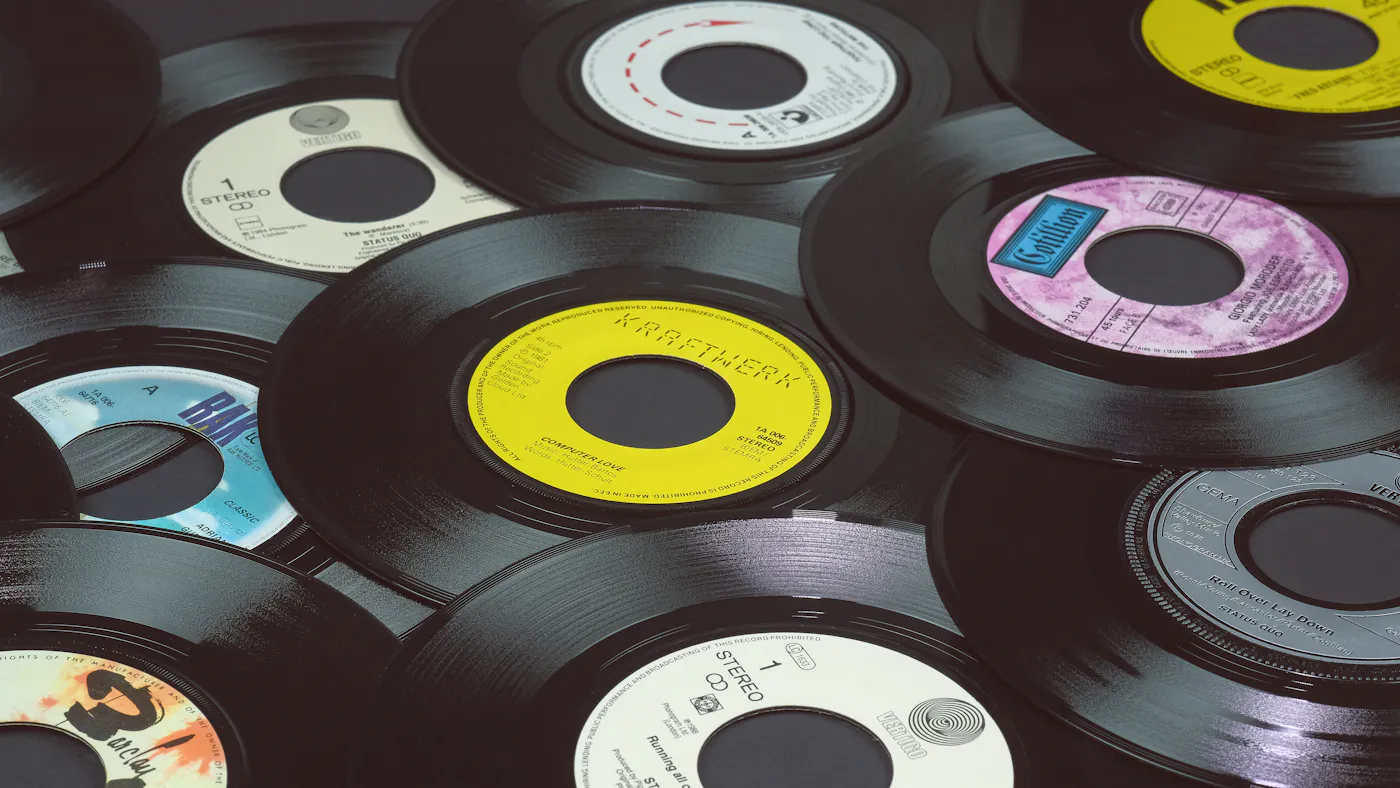
Featured image: seven-inch 45 rpm vinyl singles spread across a table, photo by Eric Krull on Unsplash, used under the Unsplash License. It is an illustrative image, not a photo of any release mentioned in this article.